Telescope buying guide for beginners
Pick a type with the chooser, then learn what to avoid.
This site does not publish a "best telescopes of the year" list. Those lists age badly and hide the real decision: which type fits your budget, targets, storage, and sky. Match the type first, then shop examples of that type.
Start with the chooser
Answer four questions on the telescope chooser for beginners. It returns a type with reasons and a deep link into the telescope view simulator so you can see an honest schematic before you spend money.
Aperture first
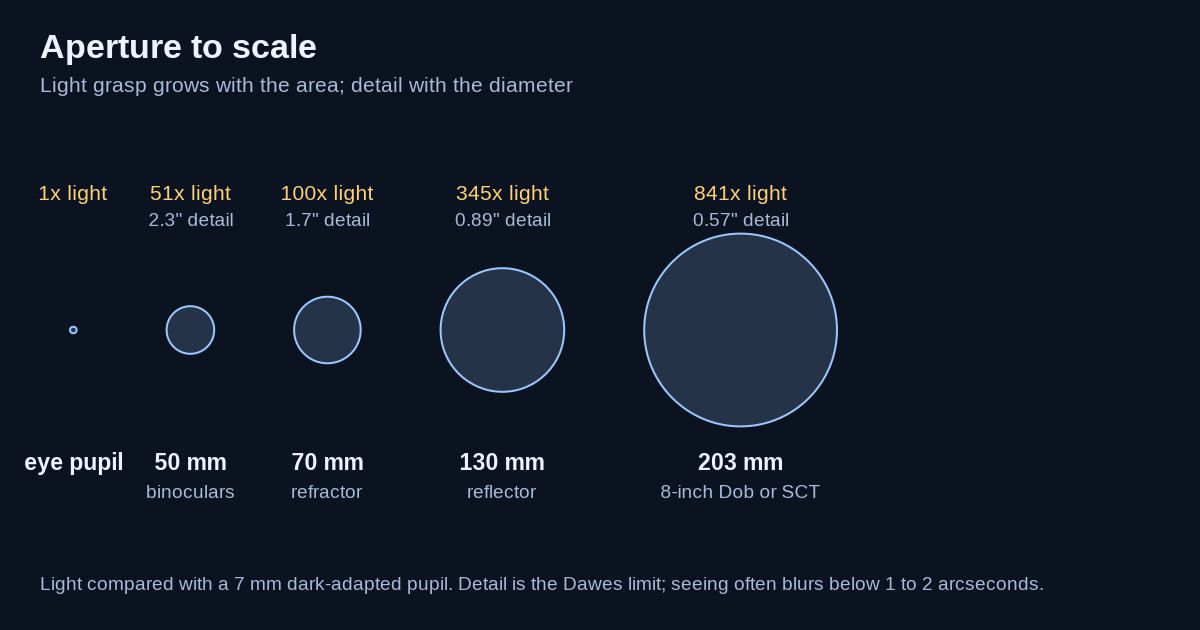
Aperture (the diameter of the lens or mirror) sets how much light you gather and how fine a detail you can resolve. Sky & Telescope's first-telescope guidance puts a practical floor near 70 mm (2.8 inches) and notes that bigger scopes show more when you will actually use them. A larger exit pupil at the same power also keeps the view brighter for extended objects, but city sky glow still limits contrast.
Mount steadiness
A sharp optic on a frail tripod shows soft, dancing views. Prefer a steady alt-az, a Dobsonian rocker box, or binoculars over empty magnification claims. GoTo electronics do not fix a wobbly mount.
Magnification claims
Ignore boxes that advertise 500x or 600x. Useful power is roughly twice the aperture in millimeters on a perfect night, and on most nights seeing limits useful power to roughly 150-250x. Buy aperture and a steady mount, then add eyepieces.
What is in the box
Expect a finder, one or two eyepieces, and (for refractors and SCTs) a star diagonal. Collimation tools, a decent finder upgrade, and a short planetary eyepiece or Barlow are common next purchases. Read the collimation guide if you choose a reflector or SCT.
Where to try one first
A local astronomy club star party lets you look through several types in one evening. That beats guessing from photos. If no club is nearby, start with the chooser and the simulator, then compare one type in person at a specialty retailer when you can.
Budget bands by type
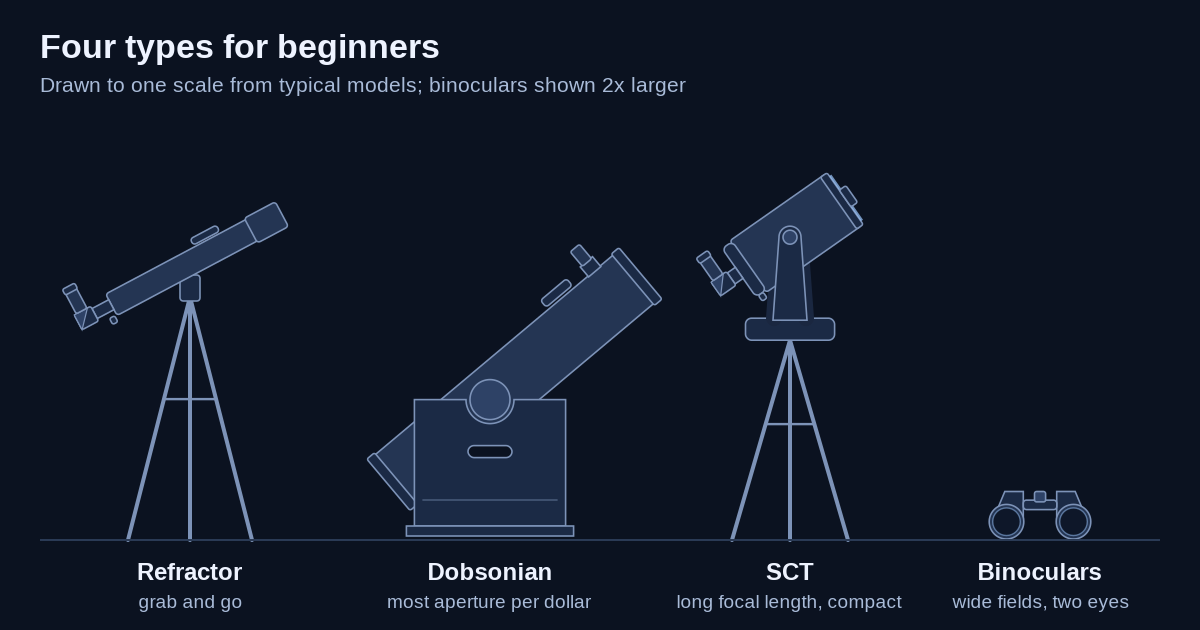
- Under about $300 with grab-and-go needs: prefer astronomy binoculars. For Moon and planets, a small refractor. For deep sky with a table or stool, a tabletop Dobsonian in the 114-130 mm class.
- $300 to $700: grab-and-go favors an 80-102 mm refractor (or a collapsible tabletop Dob). Yard space favors a 5-6 inch Dobsonian for deep sky or planets.
- $700 to $1,500: yard space usually points to an 8-inch Dobsonian. Grab-and-go points to a 5-8 inch SCT for planets or mixed targets, or an 80-100 mm ED refractor for portable deep sky.
- More than $1,500 with a fixed backyard: a 10-inch class Dobsonian is the usual visual step up; a compact SCT is the short-tube alternative.
What to avoid
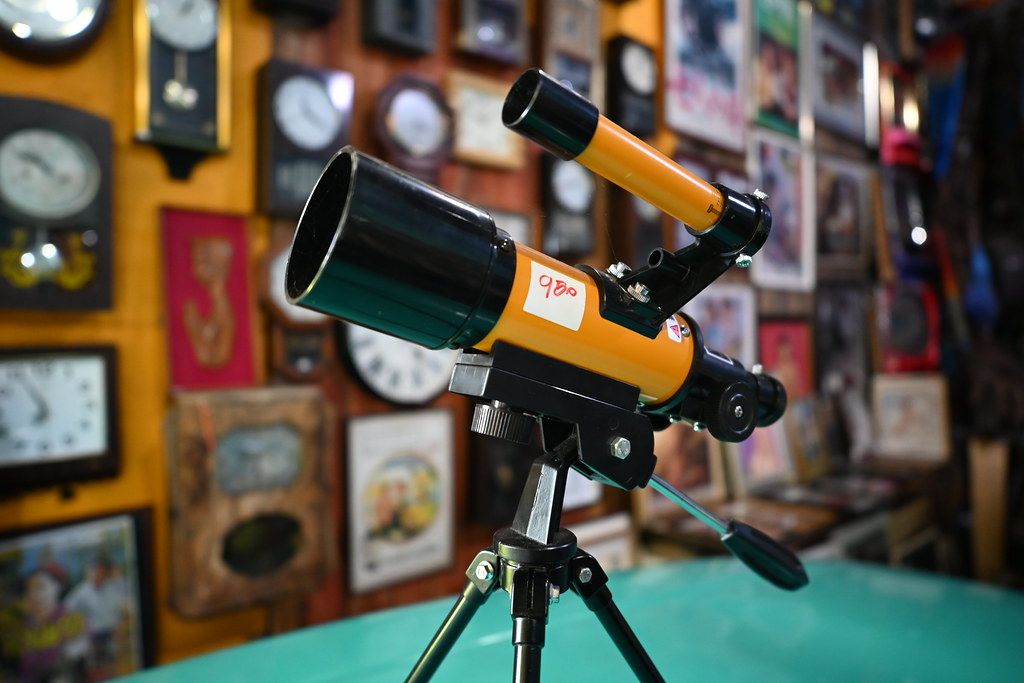
Be wary of small Newtonians on frail, wobbly tripods (often sold with 500x claims). A tabletop Dobsonian in the 114-130 mm class is a different thing: a short tube on a steady base you set on a table or stool. Also skip "smart telescope" screen-first stacks if you want a visual eyepiece view; this site's tools are for looking through glass.
Affiliates and examples
If example retailer links appear under a type, they are dated illustrations of that type, not reviews. See the affiliate disclosure.
Read what you can see with a telescope before you chase magnification claims.
Questions
What is the best beginner telescope?
There is no single best model. Match budget, targets, portability, and sky to a type, then look at examples of that type.
Should I buy a department-store telescope?
Be wary of small Newtonians on frail, wobbly tripods (often sold with 500x claims). A tabletop Dobsonian in the 114-130 mm class is a different thing: a short tube on a steady base. Prefer binoculars, a small refractor, or that tabletop Dob in this budget.
Related tools: chooser, simulator, calculator.
Sources
- Sky & Telescope, How to Choose Your First Telescope (retrieved 2026-11-24)
- Sky & Telescope, Hobby Killers: What Telescopes Not to Buy (retrieved 2026-11-24)
- Sky & Telescope, Four Telescopes for New Observers (retrieved 2026-11-24)
- This site's chooser rules (retrieved 2026-11-24)