Home / Types / Schmidt-Cassegrain
Schmidt-Cassegrain telescopes
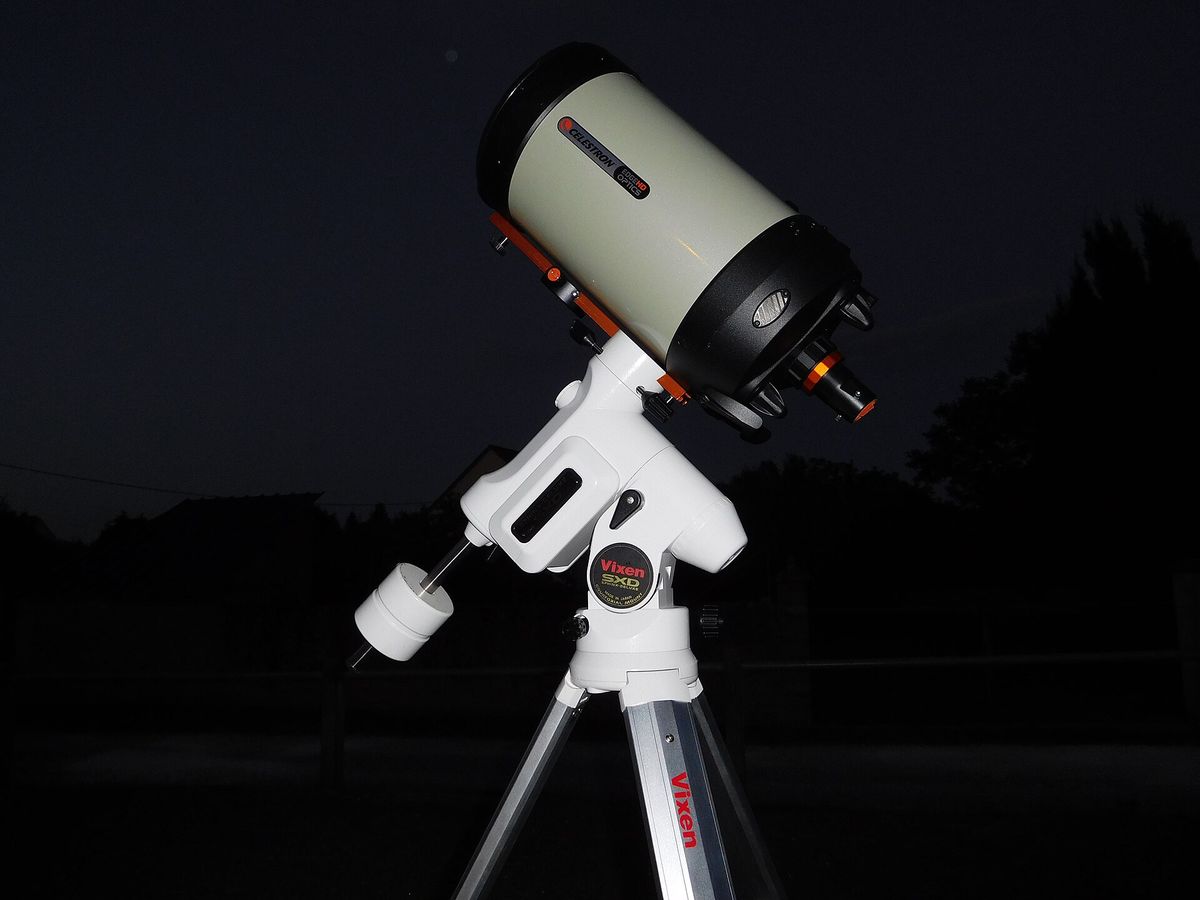
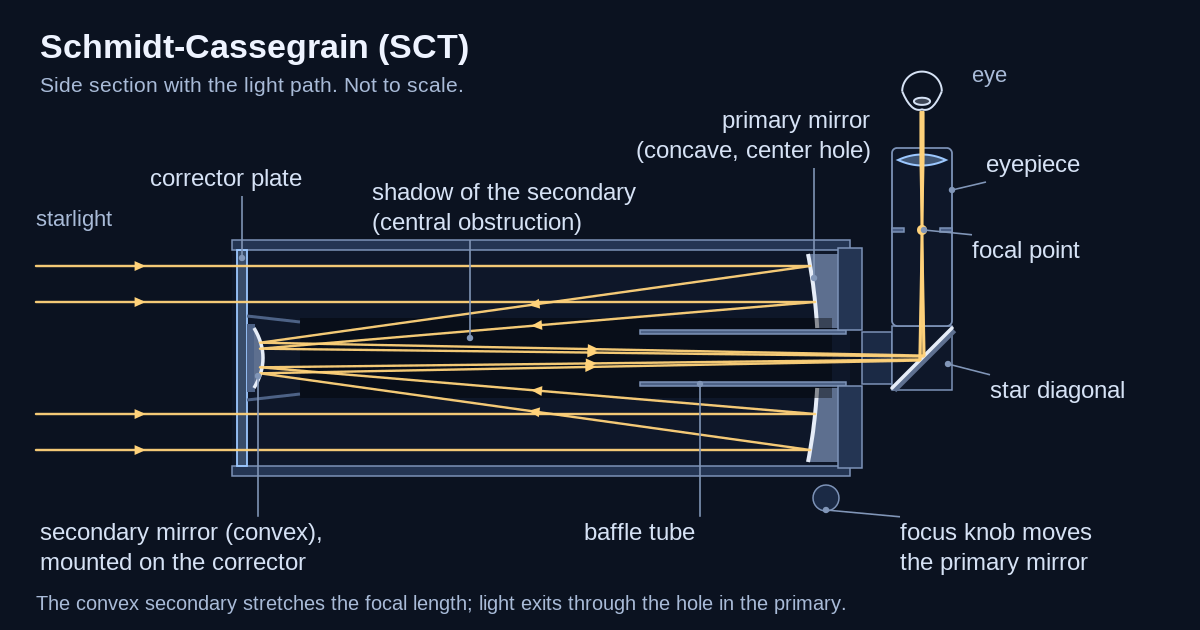
Light passes a corrector plate, reflects from a perforated primary to a secondary on the corrector, then back through the primary hole to a rear eyepiece. An 8-inch SCT packs a long focal length into a short tube. The convex secondary multiplies the fast primary's focal length about five times (for example f/2 to f/10).
Best for
Compact storage, mixed targets, and buyers who will pay more for a short tube. Try the chooser with a matching preset or open the simulator for this aperture class.
What each aperture shows
An 8-inch (203 mm) f/10 SCT with a 25 mm Plossl runs about 81x with a 2.5 mm exit pupil and roughly 0.6° true field. A 32 mm Plossl reaches about 63x and about 0.76° with a 27 mm field stop. Dawes limit is about 0.57". Teaching limiting magnitude under dark skies is about 13.2. Planets scale well; large objects like M31's outer disk need a wider true field than a typical 1.25" low-power eyepiece provides.
Typical size, weight and setup
The optical tube is short for the aperture and often fits a single arm or fork mount. The mount and tripod can still be heavy. Allow time for the mirrors to cool after moving the tube from a warm room.
Strengths
- Compact tube for the aperture
- Long focal length suits planets and smaller deep-sky targets
- Wide accessory ecosystem
Limits
- Costs more than a Dobsonian of similar aperture
- Dew on the corrector plate is common; collimation and a decent mount matter
- Cool-down time after bringing the tube outside; narrow field at low power (about 0.76° max with a 32 mm 1.25" Plossl in a 2032 mm f/10)
- Not the default first-scope path for most beginners
Collimation means lining up the mirrors so stars focus to a point. See the collimation guide.
Who should skip it
Skip an SCT as a first scope if budget is tight and you have yard storage: an 8-inch Dobsonian usually buys more visual aperture for the money. Skip it if you mainly want wide rich-field views of the Milky Way.
Accessories you will want
- A dew shield or heater for the corrector
- A low-power 1.25" or 2" eyepiece for the widest native field
- A shorter eyepiece for planets
- Patience for cool-down and occasional secondary collimation
Questions
Why is the field so narrow?
Long focal length raises native magnification. A 32 mm Plossl in a typical 8-inch f/10 only covers about three-quarters of a degree.
Is an SCT good in an apartment?
The short tube helps with storage and stairs. Budget for a steady mount and dew control.
Do SCTs need collimation?
Yes, usually a small tip of the secondary. See the collimation guide.
Calculator · What you can see · All types
Sources
- Celestron, Ultimate Guide to Optical Tubes (Schmidt-Cassegrain design) (retrieved 2026-11-24)
- Sky & Telescope, How to Choose Your First Telescope (retrieved 2026-11-24)
- Tele Vue, Telescope Formulas / Common Telescope Myths (retrieved 2026-11-24)