What you can see with a telescope
Honest eyepiece expectations for Moon, planets, and deep sky.
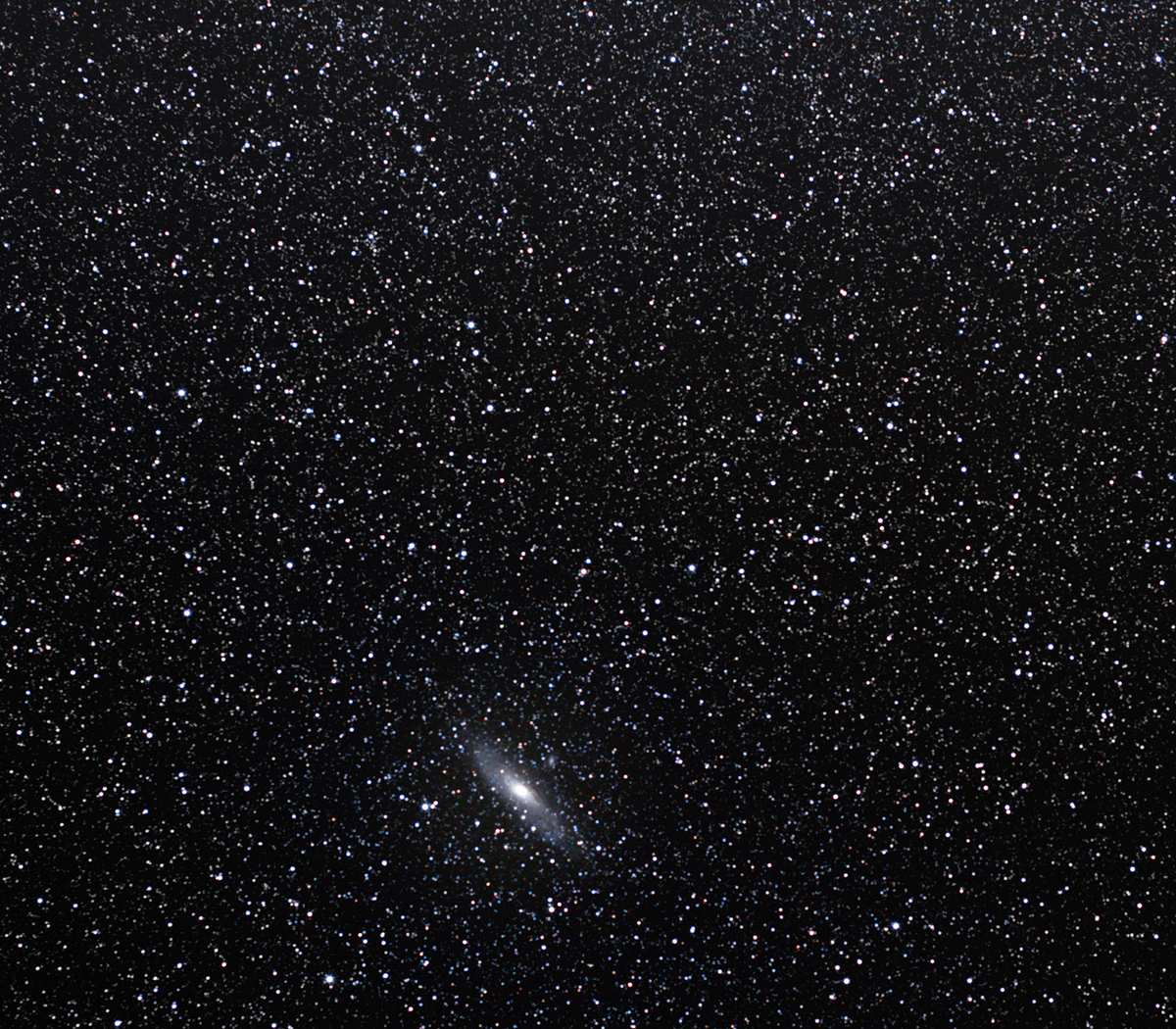
Photographs accumulate light for seconds or minutes. Your eye does not. That single fact explains most disappointment with nebulae and galaxies.
Best telescope for seeing planets
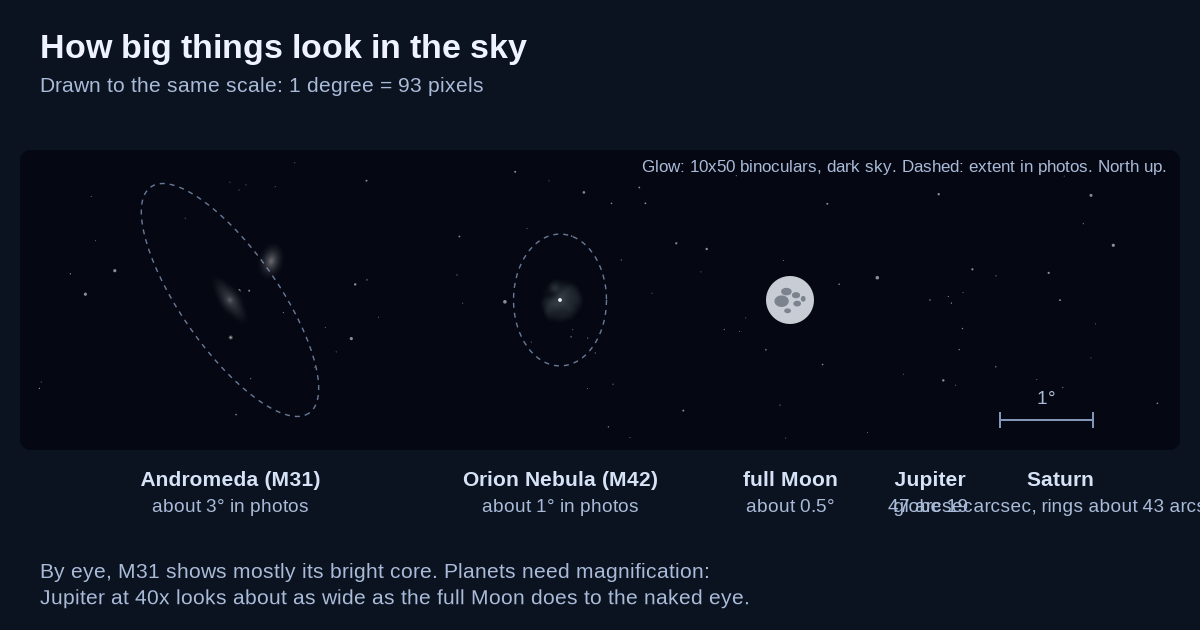
Planets reward aperture and steady air more than a long list of eyepieces. A 70-90 mm refractor already shows Jupiter's two main dark belts and up to four bright moons in a line. Saturn's rings are visible in any small telescope at about 25x and up; steady air is needed for finer detail like the Cassini Division. With yard space and a mid budget, an 8-inch class Dobsonian is the usual next step for sharper planetary disks. Colors stay muted. The disks are small on the sky: tens of arcseconds, not the poster sizes from spacecraft.
Moon
The Moon is bright and detailed even in small scopes and binoculars. Craters along the terminator stand out first; maria and bright rays follow as you learn the map.
Nebulae and galaxies
Most emission nebulae look grey because they are too dim for the eye's color cones. Andromeda's photographic oval spans about 3 degrees, but at the eyepiece a 6-inch under suburban or rural skies shows mainly a tight, almost starlike nucleus inside a very faint elongated haze that fades with no hard edge. The outer disk is only a whisper; M32 is a tiny faint fuzzy near the core, and M110 a faint small elongated smudge.
A telescope does not raise surface brightness above the naked-eye value. It makes the object larger so detection can improve, while city sky glow shrinks contrast.
Try the schematic
The telescope view simulator draws an honest eyepiece circle for the Moon, Jupiter, Saturn, M42, and M31 at preset apertures. M42 uses a grayscale photograph derivative at true angular size: under 70 mm to 8 inch it is heavily smoothed into a soft grey glow around the Trapezium, and only larger dark-sky apertures keep modest structure. M31 stays code-drawn with the same aperture and Bortle falloff. Planets and the Moon stay schematic. It is intentionally not a Hubble-color image.
If you are still choosing a first scope, start with the type chooser.
Questions
Will nebulae look like Hubble photos?
No. The eye does not accumulate light for minutes. Most nebulae look grey and faint at the eyepiece.
Can I see galaxies from the city?
Bright ones may show as faint smudges. Contrast is low under bright skies; the simulator shows that honestly.
Related tools: chooser, simulator, calculator.
Sources
- Tele Vue, Telescope Formulas / Common Telescope Myths (surface brightness and exit pupil) (retrieved 2026-11-24)
- Roger N. Clark, Visual Astronomy of the Deep Sky, Appendix E (surface brightness) (retrieved 2026-11-24)
- Sky & Telescope, Four Telescopes for New Observers (retrieved 2026-11-24)
- John E. Bortle, Gauging Light Pollution: The Bortle Dark-Sky Scale, Sky & Telescope, February 2001 (retrieved 2026-11-24)