Refractor telescopes for beginners
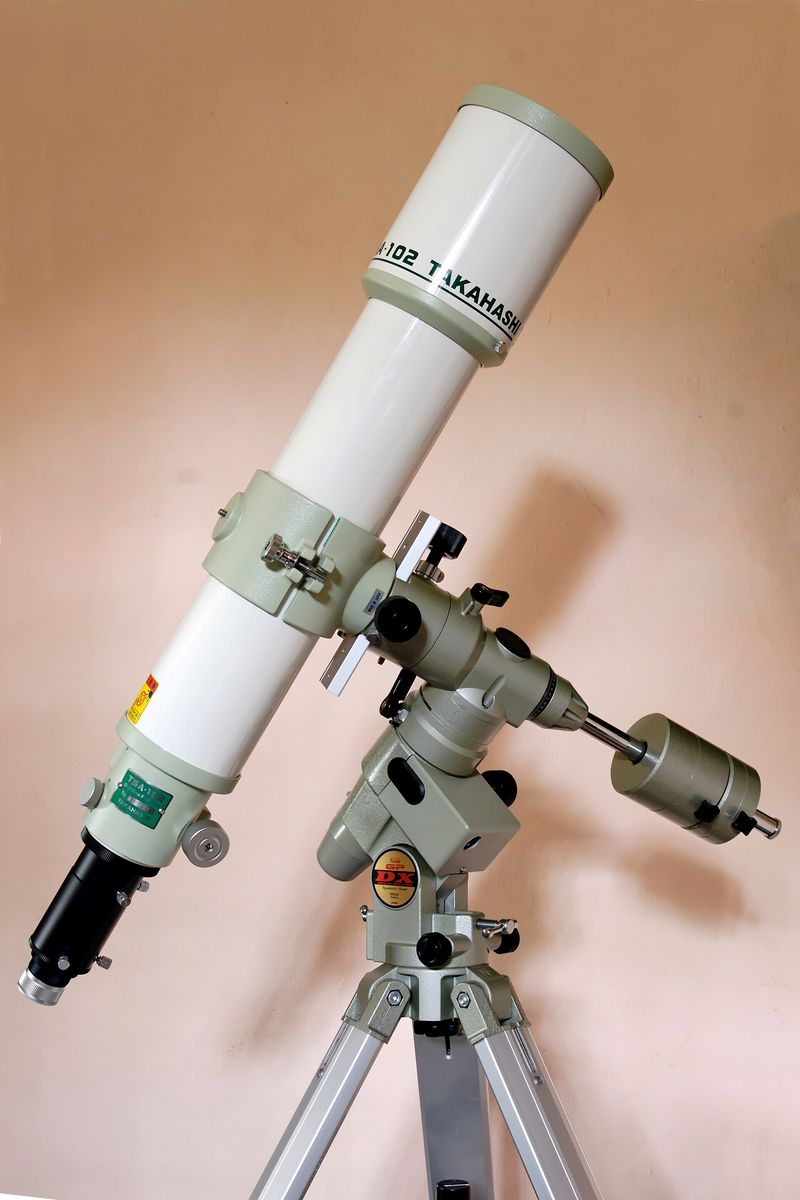
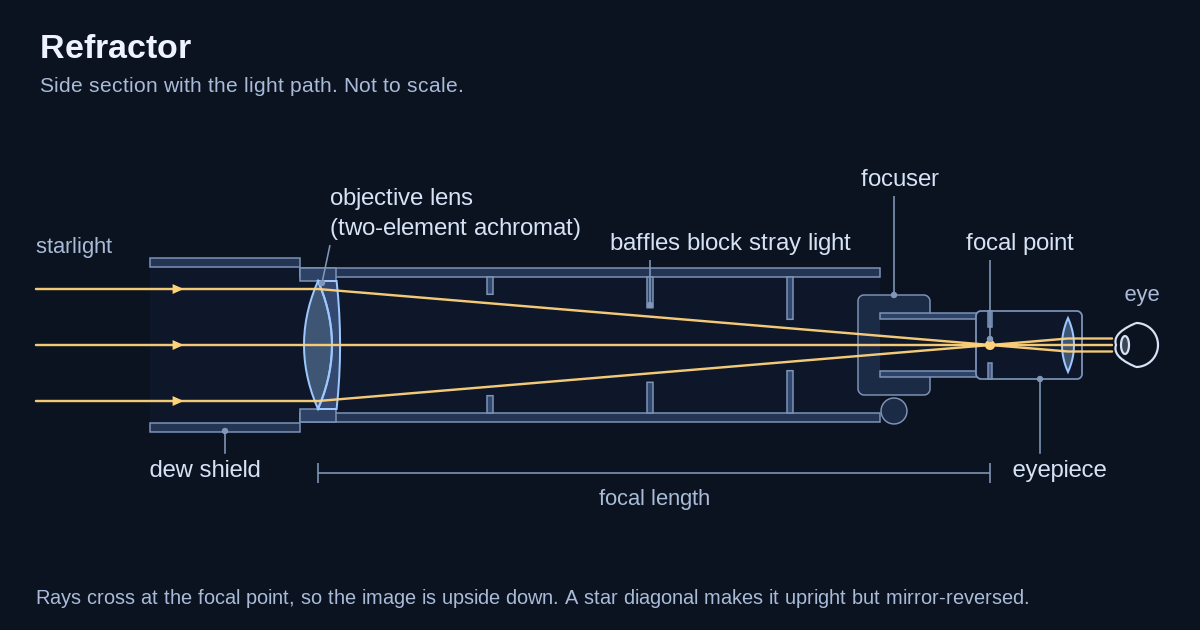
Light enters through an objective lens, travels down a closed tube, and reaches an eyepiece at the back. Beginner scopes in this family are often 70-90 mm achromats on an alt-az mount. Premium ED and apochromatic refractors cost more per millimeter but show less color fringing.
Best for
Moon, planets, grab-and-go observing, apartments and travel. Try the chooser with a matching preset or open the simulator for this aperture class.
What each aperture shows
A 70 mm f/10 refractor with a 25 mm Plossl runs about 28x with a 2.5 mm exit pupil and roughly 1.8° true field (50° AFOV). Dawes limit is about 1.66". Teaching limiting magnitude under dark skies is about 11.1. A 10 mm eyepiece gives 70x for Jupiter's belts and moons. An 80 mm f/5 short tube is wider and more portable but shows stronger false color on the Moon and bright planets; an 80 mm f/7.5 ED cuts most of that fringe. A 90-120 mm f/8-f/11 achromat gathers more light while still fringing bright planets a little.
Typical size, weight and setup
A 70-90 mm tube on a small alt-az mount often fits a backpack or apartment closet. Expect a few kilograms for the tube plus mount. Longer 100-120 mm class tubes need a sturdier tripod and more floor space when set up.
Strengths
- Closed tube stays cleaner and needs no collimation for normal use
- Quick to set up and easy to aim for Moon and bright planets
- Portable in the 70-102 mm class
Limits
- Aperture costs more per millimeter than a Dobsonian
- Simple achromats show color fringing on the Moon and bright planets
- Large apertures get long and expensive
Who should skip it
Skip a small refractor if deep-sky aperture is the main goal and you can store a Dobsonian tube and base. Skip department-store packages that advertise extreme magnification on frail tripods.
Accessories you will want
- A 25 mm or 32 mm Plossl for low power
- A shorter eyepiece or 2x Barlow for planets once you can nudge the mount smoothly
- A red-dot or optical finder
- Dew protection on humid nights
Questions
Is a refractor good for seeing planets?
Yes. A steady 70-90 mm refractor shows Jupiter's main belts and moons and Saturn's rings. With more budget and yard space, a larger Dobsonian still resolves finer detail.
Do refractors need collimation?
Not for normal use. The closed tube stays aligned unless a repair opens the cell.
Achromat or ED?
Achromats are the usual beginner price. ED and apo glass cut color fringing and cost more per millimeter.
Calculator · What you can see · All types
Sources
- Sky & Telescope, How to Choose Your First Telescope (retrieved 2026-11-24)
- Tele Vue, Telescope Formulas / Common Telescope Myths (retrieved 2026-11-24)