
Telescope magnification
How power is calculated, and why more is not always better.
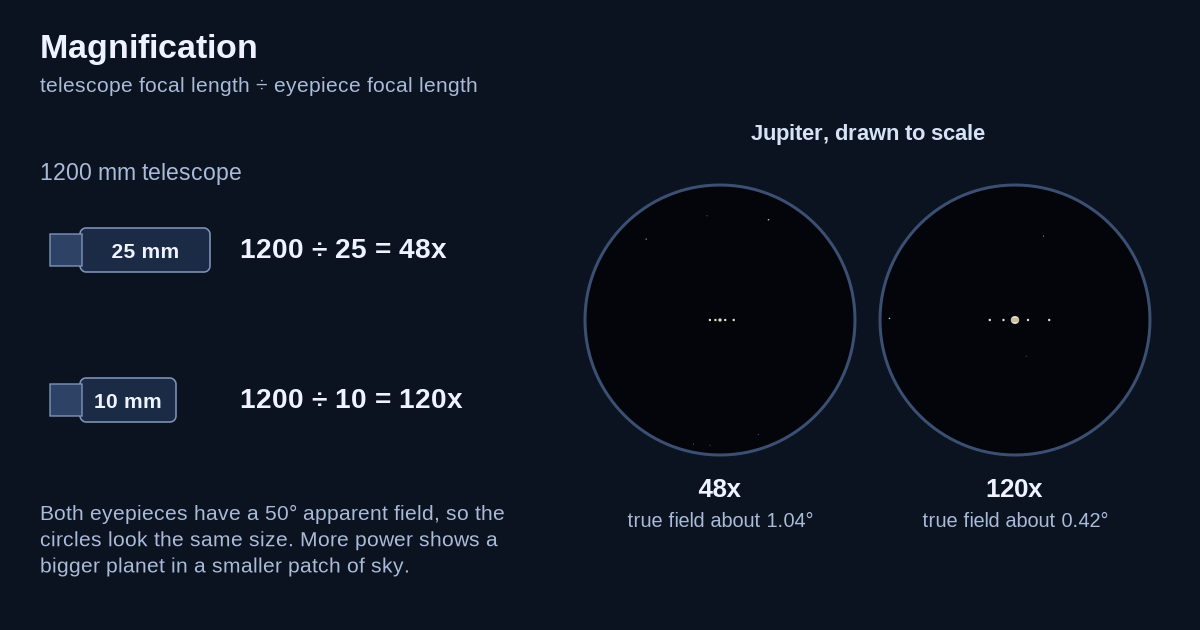
Magnification is not a quality rating. It is a ratio: telescope focal length divided by eyepiece focal length, times any Barlow factor.
Useful power versus empty power
A teaching ceiling is about 2x per millimeter of aperture (about 50x per inch). Another check is keeping exit pupil above about 0.5 mm. On most nights seeing limits useful power to roughly 150-250x, whatever the aperture; steady nights allow more.
Resolution still has a floor
Dawes' limit is about 116 / D_mm arcseconds. Rayleigh's limit at 550 nm is about 138 / D_mm. Whatever is worse between diffraction and seeing sets the detail you can split.
Bright objects first
The Moon and Jupiter tolerate higher power than faint galaxies. If the image looks grey, swimming, or dim, drop power. Larger does not mean sharper.
Run your aperture through the calculator, then check an honest schematic in the view simulator.
Questions
What is empty magnification?
Power past the point where the image gets larger but no sharper. Soft, dim, and shaky views are the usual signs.
How much power can I use on planets?
Often 100-150x on steady nights in a small scope, sometimes more. On most nights seeing limits useful power to roughly 150-250x, whatever the aperture; steady nights allow more.
Related tools: chooser, simulator, calculator.
Sources
- Tele Vue, Telescope Formulas / Common Telescope Myths (retrieved 2026-11-24)
- Tele Vue, Choosing Your Telescope's Magnification (Al Nagler, S&T May 1991) (retrieved 2026-11-24)
- BBC Sky at Night Magazine, Understanding the limits of your telescope (retrieved 2026-11-24)