
Focal ratio
What f/5 versus f/10 means at the eyepiece.
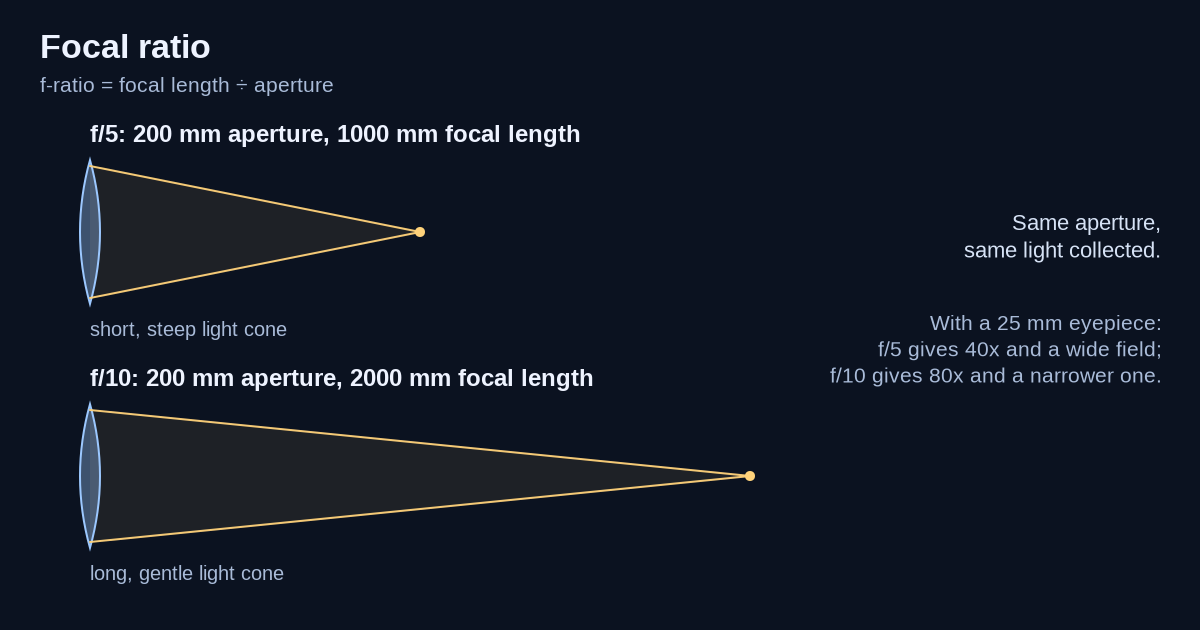
Focal ratio is f/ = F / D: focal length divided by aperture. An f/5 scope is "faster" than an f/10 scope of the same aperture.
What beginners notice
At the same eyepiece focal length, a shorter focal ratio gives lower magnification and a wider true field. That helps rich-field views and large objects. Long focal ratios raise native power, which suits planets and small targets.
What it does not mean
For visual use, f-ratio does not set image brightness. Two scopes with the same aperture at the same magnification show the same brightness, whatever their f-number. A faster scope just reaches a given low power (and a large exit pupil) with a longer eyepiece. No telescope shows an extended object brighter than it looks to the naked eye; it only makes it bigger. Contrast against the sky still rules deep-sky views.
Eyepiece behavior
Fast mirrors and lenses ask more of eyepieces at the edge of the field. That is one reason a simple Plossl can look fine in an f/10 SCT and show soft, smeared stars toward the edge in an f/5 Newtonian (eyepiece astigmatism plus the mirror's coma).
Compare focal ratios for the preset scopes on the calculator.
Questions
Is a faster scope better?
Faster (lower f-number) scopes give wider fields at a given eyepiece. They do not automatically show fainter galaxies. At the same aperture and magnification, visual brightness matches.
Why do SCTs have long focal ratios?
The convex secondary mirror multiplies the fast primary's focal length about five times (for example f/2 to f/10), so a short tube gets a long focal length.
Related tools: chooser, simulator, calculator.
Sources
- Tele Vue, Telescope Formulas / Common Telescope Myths (retrieved 2026-11-24)
- Tele Vue, Choosing Eyepieces (Basic) (retrieved 2026-11-24)
- Celestron, Ultimate Guide to Optical Tubes (Schmidt-Cassegrain design) (retrieved 2026-11-24)