
Barlow lenses
How a Barlow multiplies power, and when to skip it.
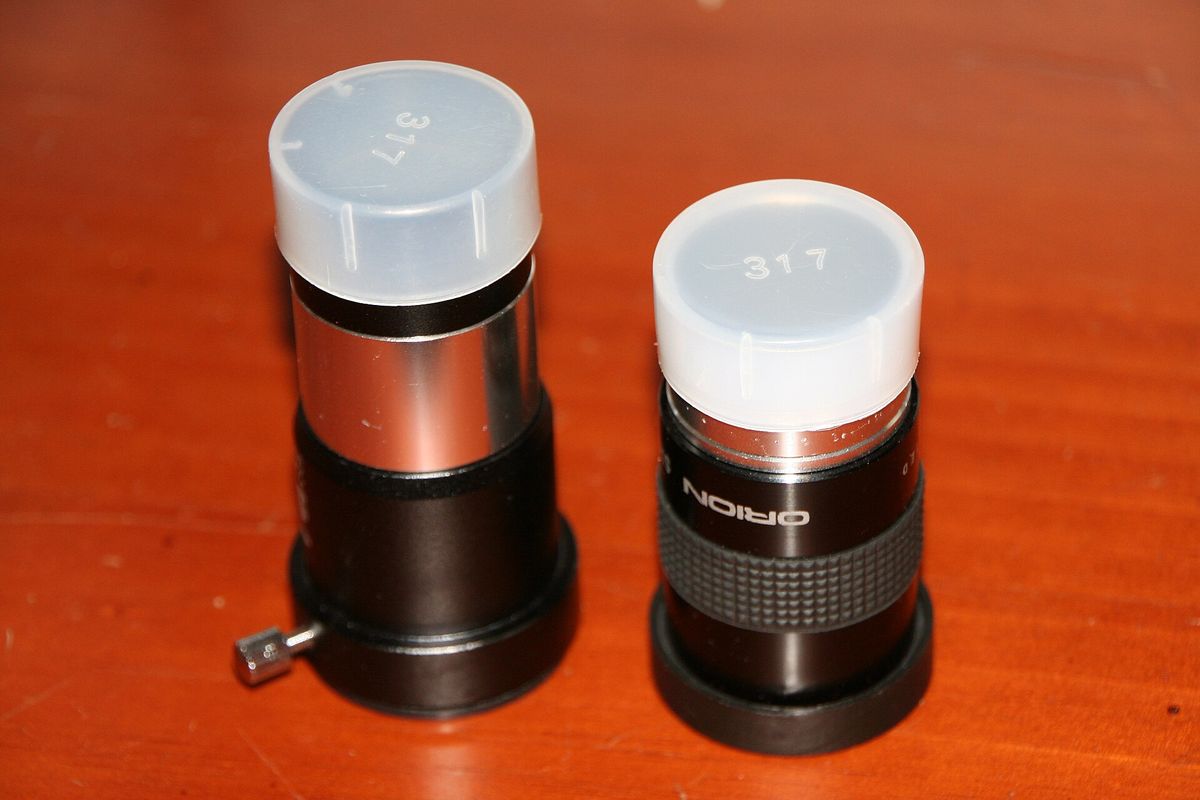
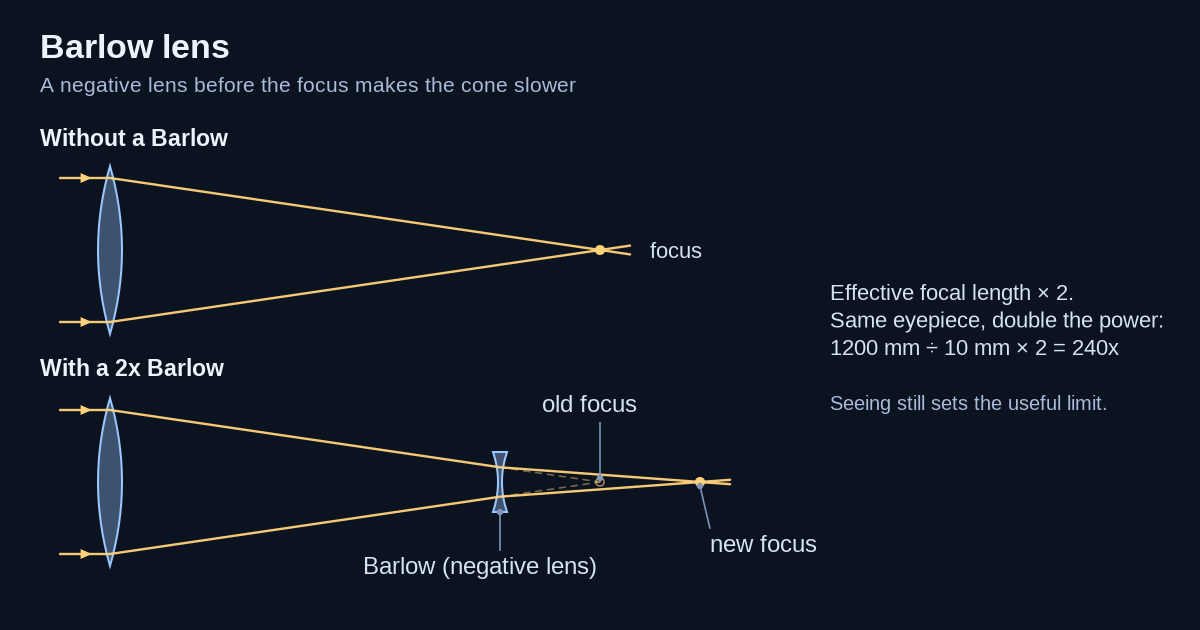
A Barlow lens sits ahead of the eyepiece and multiplies the telescope's effective focal length. A 2x Barlow doubles magnification for every eyepiece you already own.
What it changes
If a 25 mm eyepiece gives 40x, a 2x Barlow makes that combination 80x. Exit pupil halves. True field shrinks. You did not add aperture; you only changed power and field.
When it helps
A Barlow is useful when you want planetary power without buying every short eyepiece. It lets you reach high power with a longer eyepiece, which usually has more comfortable eye relief. It does not fix a shaky mount or bad seeing.
When to skip it
If the view is already soft at native power, multiplying further is empty magnification. On most nights seeing limits useful power to roughly 150-250x, whatever the aperture; steady nights allow more.
Try the same scope with and without a Barlow factor in the calculator and the simulator.
Questions
Does a Barlow improve the view?
It increases magnification. Detail only improves if the seeing, collimation, and aperture support that power.
Is 2x or 3x better for beginners?
A 2x Barlow is the usual starter. Higher factors push you into soft, over-magnified views faster.
Related tools: chooser, simulator, calculator.
Sources
- Tele Vue, Telescope Formulas / Common Telescope Myths (retrieved 2026-11-24)
- Tele Vue, Choosing Your Telescope's Magnification (Al Nagler, S&T May 1991) (retrieved 2026-11-24)